
EIA Report for Barachois IRS Project by Barachois Villas Company Ltd -
Tamarin
Introduction
1. The Promoter & Statement of Purpose
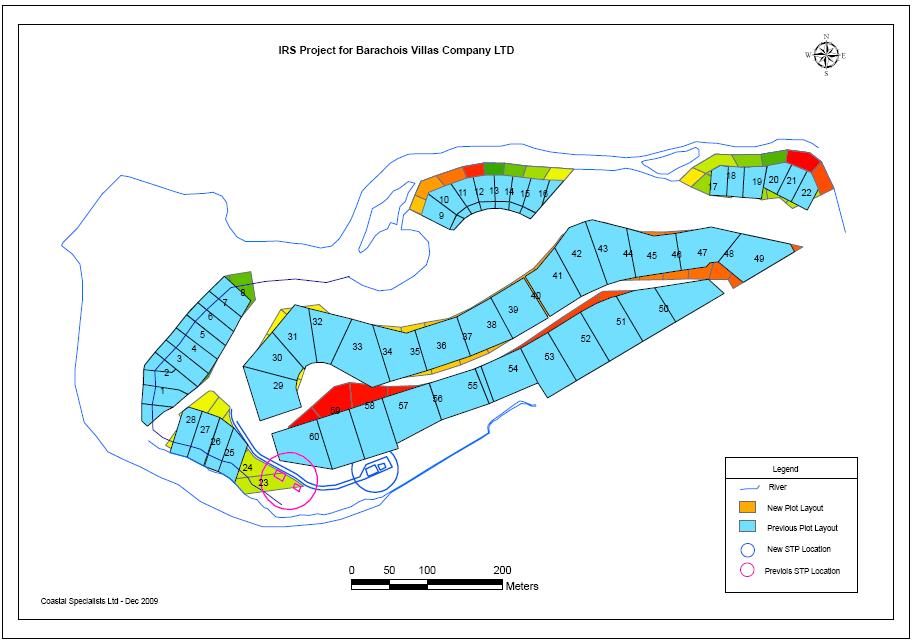
The project is being initiated by Barachois Villas Company Ltd and will be implemented at a site called Barachois along the Rempart River in the village of Tamarin situated in the district of Black River. The land to be developed has an extent of 246,414.4m2 and is currently owned as a freehold land by Societe R. Jhuboo & cie (SRJ) as per title deed at annex 1. The Medine Sugar Estates Co Ltd (MSE) has been the first company to conceptualize and implement an Integrated Resort Scheme in Mauritius. Following the success of the Tamarina Golf Estate and Beach club, MSE reached an agreement with SRJ to develop 51 villas of the IRS type at Barachois Estate, Tamarin. The company is registered under the company “Barachois Villas Company Limited.
The Project will consist of a high profile residential development adjoining Tamarina Golf Estate and extending partly along a rocky promontory and partly along the Rempart River. The ideal geographical location as well as its natural extension to the Tamarina Golf Estate prompted the Architect and the management team to prepare a
master plan that integrates the proposed project in a very logical manner respecting visual, architectural, planning and environmental parameters. By so doing it also maintains the high economic perspective of the overall area.
The proposed project will be built on 24.64 hectares and will consist mainly of the
followings: -
• 26 villas (zone 5)
• 25 river villas(zone 1-4)
• Restaurant complete with deck and pontoon (zone 3)
• A common pontoon along the nearshore river bank (zone 2).
The villas for this proposed project will be built on the same architectural design as the villas at Tamarina Golf Estate. The villas will be low pitched and will provide for continuity and visual harmony. Natural materials such as stone and timber will be used extensively thus blending with the savannah type of environment.
2 The Benefit
In the wake of this project the Medine Sugar Estates Co Ltd has carried out a social need analysis as well as a social impact assessment of the proposed project. This has resulted in a dozen recommendations listed in the Medine Master Plan 2005-2025. MSE has already set up the necessary funding instruments and processes for the disbursement of funding in support of social integration around the Barachois IRS
project.
The promoters foresee the creation of approximately 1,200 jobs during the construction phase and more than 100 permanent jobs during the running phase of the project. The budget earmarked for social integration activities for the Barachois IRS Project amounts to MUR 9,800,000. Details of allocation of these funds are further elaborated in the main report. The multiplier effect through indirect jobs and economic ventures is foreseeable.All elements which reflect policy of the Government to provide for sustainable employment, to raise the social standard of the local population, to provide for a formal integration of the local population through diverse economic benefits, empower people and backup as well as on a more national platform, accelerate Foreign Direct Investment, tax collection and all this with respect to the environment as per different protocols where the Government of Mauritius is signatory, is addressed positively in this project. On the Environmental perspective such a project integrates well with adjoining developments namely the Tamarina IRS as well as other low density but high profile developments. Owing to the high profile target, set in terms of environmental standards the end result will be beneficial to the receiving environment.
Thus the project has compounding effects on the overall physical, economic, social, and ecological environment. Such a project should be promoted.
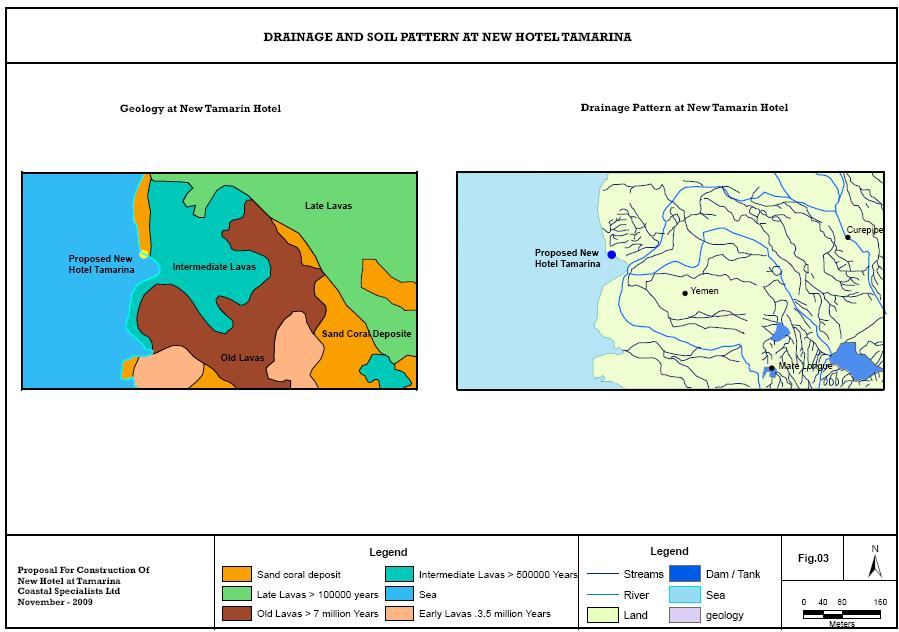
Project Description (Figs. 1, 2, 3, 5)
3.1 Introduction
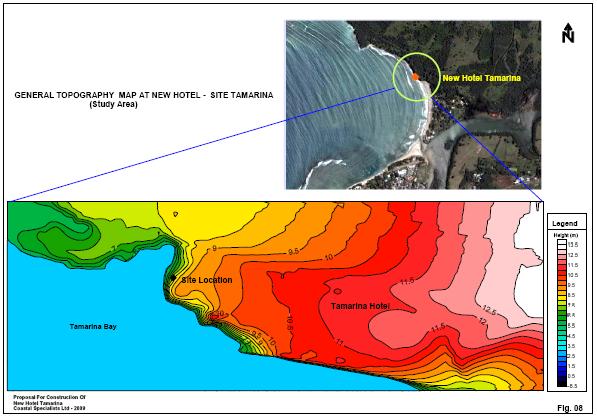
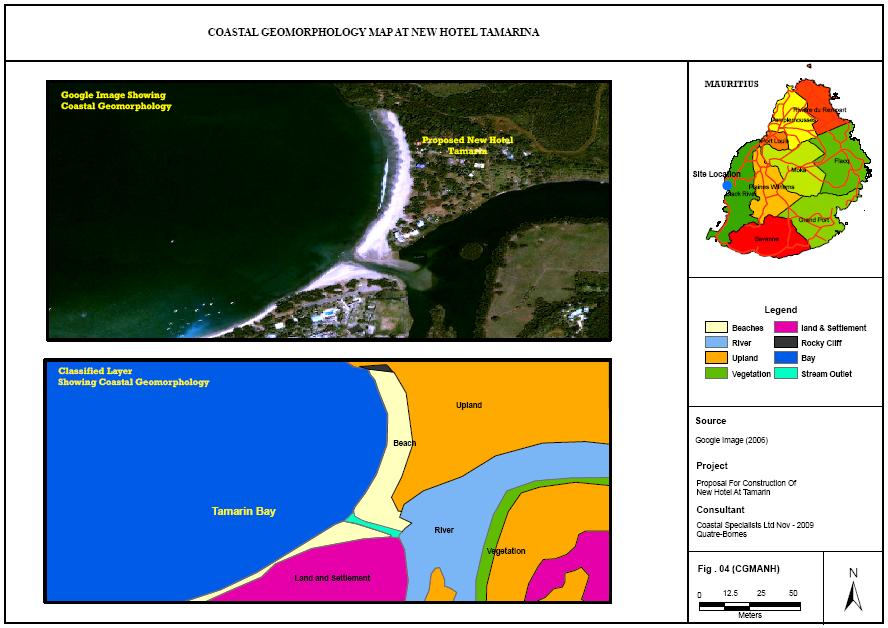
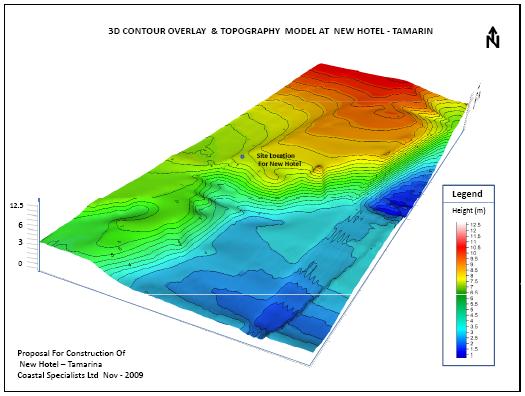
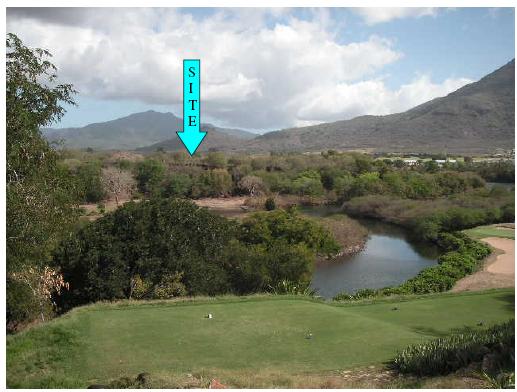
Part of the proposed site for development viewed from Tamarina Golf Estate The site is ideally and strategically located, visually captivating, peaceful and environmentally diverse. Its topographic disposition, with a high plateau and a river plain gives it character. Undulating river adjacent to the site with its constant murmur would enchant the most conservative guest who is in quest of tranquility. It is indeed
a site of inspiration and calmness and presents a unique opportunity to invigorate oneself.
The project will maximize its effort in terms of Environmental friendliness, low density development, use of natural materials like rock and wood, use of the best engineering practices and methodology, effective monitoring of standards to respect and preserve the characteristics of this site as described above. With the big success of Tamarina Golf Estate & Beach Club it was inevitable that the
proposed site be developed inline with the concept of IRS. The project integrates well in the overall context and respects relevant planning guidelines (figure 5). The Barachois Villas Ltd under the very able cooperation of the Medine Sugar Estates Co Ltd and Societe R. Jhuboo & Cie is proposing to develop 51 villas of the IRS type on 24.64 hectares of freehold land, based on the same architectural design of the
Tamarina Golf Estate & Beach Club. The present project will go a step further in terms of its quality as well as the overall upgrade in luxury level of the product. It is projected that implementation of this project would cost MUR 1.6 billion. The different components of the project proposal are listed hereunder with relevant details:
3.2 Details of Project components (Figs. 2 Master Plan)
The total land area which is under full ownership has an extent of 246 414.4 m2
3.2.1 Details of Villas (type AA, CC, DD, EE, D,E- Figs. 8A-8L)
No of units 26
Average size of plots: 3,500 m2
Average Unit surface area: 400 m2
These villas will be constructed on the high plateau.
3.2.2 Details of River Villas (Figs. 8M-8P)
No. of units: 25
Average size of plots: 700 m2
Unit surface area: 260 m2
3.3 Restaurant (Figs. 8O-8P)
A restaurant will be built at zone 3. It will have an open deck overlooking the pond and the river. The deck will be partially connected to the pond via a jetty and a pontoon. The jetty and pontoon will be built on piers and will have a wooden deck surface.
Average size of Restaurant: 485 m2 The above development represents 14% of the land area available for development.
3.4 Jetties and Pontoons (zone 2)
The proposed project has a frontage which is muddy and does not present safe access for such a high profile development. Whereas it is the firm intention of the promoter to preserve the natural disposition of the coastal frontage of the project, it is also felt that safe access to the water features will benefit residents and guests. Observation of
the natural beauty of the site and access to non-motorised water sports will be the key factors for providing such facilities. It is proposed to build a common pontoon on pier at zone 2. This pontoon will be
connected to shore via a jetty built on piles. The deck will be made of treated wood and a light structure kiosk will be built on the pontoon.
1 Environmental Impacts
The scope of work and work methodology may have the following impacts on the physical environment. A list of potential impacts is listed below: -
• Destruction of vegetation and habitat
• Land Erosion
• Sewage Pollution
• Solid waste pollution
• Dust
• Noise
• Traffic
• Pollution from Hydrocarbons
• Pollution and degradation of river
It is to be noted that these potential impacts have been identified right from the design stage and the overall project methodology takes these on boards while planning the implementation phase.
2. Mitigative Measures.
Waste water is possibly the single most important source of pollution from a residential development. At present less than 20% of the population is connected to a sewer network. The rest discharge wastewater into the ground, with or without the preliminary conditioning provided by septic tanks. This practice is not without danger to our ground water resources. It is imperative therefore that any wastewater disposal system be designed with a view to protect underground and other water resources.
In mitigation of the various possible effects of the discharge of wastewater, the proponent shall adopt such measures as shall be decided by the WMA or other Authorities. In general, an appropriate system of treatment and disposal should be adopted. The several possibilities which have been considered are discussed below:
[1] Connection to a Sewer Network. No Sewer network exists in the vicinity to which effluent could be pumped. Autonomous sewerage systems exist in the adjacent development, where septic tanks and RBC treatment plants have been installed, and the treated effluent is used for irrigation of green spaces. However, their capacities have not been calculated to cater for the present development.
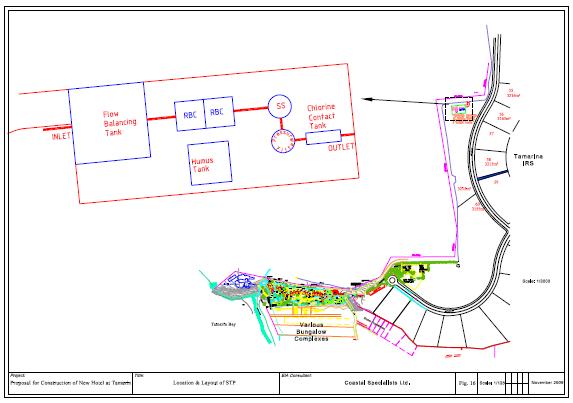
[2] On-site treatment for off-site disposal and/or irrigation. This would involve a mechanised treatment plant such as an activated sludge plant or the so-called RBC, tertiary treatment and disinfection before disposal in a watercourse, such as the one passing near the site or for irrigation. The treatment plant, whatever the type mimics natural processes at an accelerated pace induced by the high concentration of bacteria and added oxygen, to reduce BOD5, and sometimes, other nutrients such as Nitrogen and Phosphorus. The system involves both primary and secondary sedimentation, and typically suspended solids may be reduced to 20 mg/l. Rapid or slow sand filtration or pressure filters provide a “polish” whilst ensuring the removal of helminth eggs. Finally, disinfection by the application of chlorine, by UV radiation or by the application of Ozone, will ensure the removal of pathogens. In general, the use of either UV radiation or chlorine is preferred, although the latter is less efficient in the removal of viruses; ozone treatment is expensive and normally used for drinking water. In the case under discussion, the daily production of wastewater is not of such a volume as to make the use of an activated sludge treatment plant feasible. If the treatment option is maintained, it would necessitate the use of RBC treatment plants.
[3] Wetlands.
a. Constructed and natural wetlands are often used as low-tech treatment systems for domestic wastewater effluent, from single-residence septic tank effluent wetlands to large municipal wastewater treatment facilities. Similarly, wetlands may be used effectively for treatment of animal and aquaculture wastes.
b. Constructed wetlands treatment systems are engineered systems that have been designed and constructed to utilize the natural processes involving wetland vegetation, soils, and their associated microbial flora to assist in treating wastewater. They are designed to take advantage of many of the same processes that occur in natural wetlands, but do so within a more controlled environment. Some of these systems have been designed and operated with the sole purpose of treating wastewater, while others have been implemented with multiple-use objectives in mind, such as using treated wastewater effluent as a water source for the creation and restoration of wetland habitat for wildlife use and environmental protection.
c. Although a broad spectrum of designs has been used for wetland treatment systems, all can be classified as either surface-flow (SF) or subsurface-flow (SSF) systems. The SF design typically incorporates a shallow layer of surface water, flowing over mineral (sandy) or organic (peat) soils. Vegetation often consists of marsh plants, such as cattails and reeds, but may also include floating and submerged aquatic vegetation, as well as wetland shrubs and trees. Natural wetlands have also been effectively utilized as SF treatment wetlands. In a SSF wetland, the basin is filled with gravel or some other coarse substrate, and the water level is maintained below ground. Water flows horizontally, or sometimes vertically, through the gravel and the root mat of the wetland vegetation. Each type of treatment wetland has characteristic advantages and limitations for treatment of various wastes.
d. Dissolved biodegradable material is removed from the wastewater by decomposing microorganisms which are living on the exposed surfaces of the aquatic plants and soils. Decomposers such as bacteria, fungi, and actinomycetes are active in any wetland by breaking down this dissolved and particulate organic material to carbon dioxide and water. This active decomposition in the wetland produces final effluents with a characteristic low dissolved oxygen level with low pH in the water. The effluent from a constructed wetland usually has a low BOD as a result of this high level of decomposition. Aquatic plants play an important part in supporting these removal processes. Certain aquatic plants pump atmospheric oxygen into their submerged stems, roots, and tubers. Oxygen is then utilized by the microbial decomposers attached to the aquatic plants below the level of the water. Plants also play an active role in taking up nitrogen, phosphorus, and other compounds from the wastewater. This active incorporation of nitrogen and phosphorus can be one mechanism for nutrient removal in a wetland. Some of the nitrogen and phosphorus is released back into the water as the plants die and decompose. In the case of nitrogen much of the nitrate nitrogen can be converted to nitrogen gas through denitrification processes in the wetland.
e. There remain, however, concerns over the possibility of harmful effects resulting from toxic materials and pathogens that may be present in many wastewater sources. Also, there are concerns that there may be a potential for long-term degradation of natural wetlands due to the addition of nutrients and changes in the natural hydrologic conditions influencing these systems.
If utilised, wetlands should be designed to accept raw effluent, rather than septic tank effluent. Even then, risks of odour and fly nuisance are not completely eliminated. But its use for further treatment of septic effluent will definitely generate odour, and upset the local eco-system.
Another problem associated with wetlands is the proliferation of mosquitoes, because of the presence of aquatic plants as well as vegetation on the banks of the pond. This is a source of danger to the health of animals on the farm.
Also, the design of such systems is still empirical, and the present state of research does not allow accurate prediction of its performance.
In conclusion, we are of opinion that, unless there is a definite policy of providing a habitat for wildlife, engineered wetlands as a means of treatment can in general only be considered with considerable reservation in the local context. In the particular context of this site, it is not recommended.
[4] Septic Tank and Absorption System. A septic tank system comprises a septic tank and an absorption system, generally, a leaching field. The modern septic tank retains and stores solid matter that is flushed with the effluent while allowing the liquid portion of the waste to pass through to the leaching field. A certain amount of solid digestion takes place inside of the septic tank, which helps control the rapid buildup of solid matter. The solids in a septic tank can be divided into three categories: those that float on the water, such as grease; those that settle to the bottom, such as paper and ground garbage; and those that are suspended in the liquid, such as partially digested solids.
Because of modern living patterns and the resulting waste disposal habits, a septic tank should be pumped out every three years. A septic tank will fill with solids if it is not pumped out, and the solids will then flow out of the tank with the liquid. This will shorten the useful life of the leaching fields by physically clogging the soil pores.. An inspection of the baffles in the tank is extremely important and very cost effective, because the function of the baffles is to retain the floating solid layer in the tank. These baffles should be checked each time the tank is pumped because they may deteriorate as a result of the biological activity in the tank. The cost of replacing a defective baffle is far less than the cost of replacing a leaching system that has been ruined.
[5] The function of leaching fields is to further purify and disperse the liquid from the septic tank into the soil without polluting the ground water. The four most common types of leaching fields are trenches, beds, galleries, and pits (drywells). The type and size of field is determined by the soil conditions. In soils with slower drainage characteristics, a larger field is needed. In sand and gravel-type soils, less leaching area is required.
[6] All septic systems function in the same general manner, piping wastewater into a septic tank where solids fall out as sludge or float to the top as scum. Through bacterial action, some of the solids are digested and converted to liquid for discharge into a "soil absorption area." The remaining solids accumulate and must be removed for disposal in an approved waste facility, usually a Sewage treatment works. The septic tank was patented in London, England around 1900 and is described in Webster's Dictionary as "a tank in which waste matter is decomposed through bacterial action." The modern septic tank is a two-chambered watertight box usually made of precast concrete, concrete blocks or reinforced fiberglass. When waste material enters the box, several things occur:
1. Organic solid material floats to the surface and forms a layer that is commonly called "scum." Bacteria in the septic tank convert this material into liquid.
2. Inorganic or inert solid materials that cannot be biologically converted and the by-products of bacterial digestion sink to the bottom of the tank and form a layer commonly called "sludge."
3. A cloudy liquid lies between the two layers and is the only ingredient that should overflow into the soil absorption area.
4. To work properly, there should be enough volume in the septic tank so that it takes at least 24 hours (the WMA requires 48 hours) for the water to pass through into the leach field. If shorter, the solids will pass over into and plug the leach field. Periodic pumping or cleaning out of the tank is required to keep sufficient liquid volume in the tank.
5. The overflow of solid material into the soil absorption area should be avoided because it will clog soil pores in the absorption area and result in system failure. Three factors contribute to solid material overflow: a) effluent flows exceeding the design capacity, b) bacterial loss and c) scum and sludge accumulations that reduce the liquid capacity of the tank.
The size of the septic tank to be installed is based upon the average flow. The minimum size recommended is 3 m3 effective capacity
Bacteria must be present in the septic tank to digest the organic solids. Normal household waste provides enough bacteria to digest the solids unless the bacteria are killed. Bacteria are very sensitive to environmental changes and may be destroyed by such common home-care products as:
|
Detergents |
Cleaning compounds |
|
Acids |
Disinfectants |
|
Polishes |
Caustic drain openers |
|
Bleach |
Sink and tub cleaners |
|
Alcohol |
Toilet cleaners |
|
|
Petroleum products |
Small, dilute doses of these household products are not a threat to the bacteria in the system. Finally, there is no need for any additive to enhance bacterial activity.
[7] A septic tank is a basic primary sewage treatment system and a retention period of one to three days in the tank provides settlement and partial digestion of the organic solids. The tank is usually divided into two connected compartments (although the old 3-compartment design may still be used) to reduce turbulence and encourage settlement. The volume of the first compartment is usually twice the volume of the second compartment.
The septic tank effluent can then be disposed of to the ground through a soakage system. The soakage system provided must be effective in disposing of the tank effluent with minimum risk of blockage and overflowing.
A two-compartment septic tank is now generally preferred. The first compartment is usually twice the size of the second. The liquid depth is 1 to 2 meters and the overall length to breadth ratio is 2 or 3 to 1.
[8] Subsurface disposal into soakaway pits is the most common method of disposal of the effluent and the two essential site conditions necessary for the good performance of a soakaway are met by the following:
· The soil is sufficiently permeable.
· Sufficient land for effluent disposal is available.As will be shown, the quality of the soil does not allow the use of such systems. However, the use of RBC treatment plants would still require the use of septic tanks without the absorption component.
Conclusion
This project is fully committed towards providing a high profile development within all planning and environmental norms. It has a far reaching as well as sustainable positive impact on people and society. As stated in this document, its benefit to the country in terms of revenue is immense. It is a project that commits itself to protect the natural environment with reference to endemic, native and rare plants as well as attributes of the water bodies. The promoters therefore request the authority to review this project positively and grant the necessary permits.